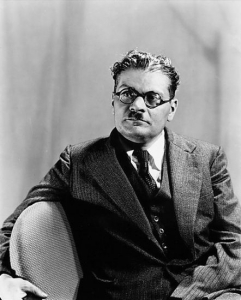
Diego Rivera 1925 on José Clemente Orozco, in: Wolfe, The Fabulous Life of Diego Rivera (dieser beitrag wurde verfasst in: englisch)
eingetragen von Alex Winiger am 16.03.2016, 10:34 (email senden)
José Clemente orozco, along with the popular engraver, José Guadalupe Posada, is the greatest artist whose work expresses genuinely the character and the spirit of the people of the City of Mexico, in which, though born in Zapotlán, Jalisco, he has lived from early childhood.
Typical criollo, of the petty bourgeoisie, he frankly says: «In a people of Indians we feel as if we were in China.»
Sullen and crippled — by an artillery accident as a child — he maintains at bottom a great tenderness, which he hides out of modesty and an instinct of defense.
Excessively conscious of his genius, his character is bitter because he never feels that he is sufficiently recognized and has been too long unappreciated.
Profoundly sensual, cruel, moralistic, and rancorous as a good, semiblond descendent of Spaniards, he has the face and mentality of a servant of the Holy Office.
And it is with the fury of an Inquisitor that he persecutes sinful love in dens of pleasure and attacks the degenerations and defects of rich and poor.
His terrible amorous temperament, restrained by the brake of his pride, his timidity, in daily life, overflows in his painting.
Like Posada, he is an anarchist, instinctive, profoundly romantic; and, as such, in all his work one feels the simultaneous presence of love, of pain, and of death.
Louis Gillet, José Clemente Orozco, dans: Michel, L'histoire de l'art, 1929 (dieser beitrag wurde verfasst in: französisch)
eingetragen von Alex Winiger am 16.03.2016, 10:34 (email senden)
Un autre maître, José Clemente Orozco, dans le triple étage de ses fresques de l'École préparatoire, parvenait par des voies différentes à l'art monumental. Celui-là est un autodicacte, qui doit tout ce qu'il sait à un bref séjour aux États-Unis et à son démon personnel. Sa palette, plus concentrée, se compose de terres, d'un orchestre de bistres et de gris, où jouent quelques jaunes et un bleu pâle. Dans ces tons neutres et abstraits, par une suite d'essais volontaires, à force d'effacer et de détruire ses ouvrages, l'artiste en a produit quelques-uns, La tranchée, La destruction de l'ancien ordre de choses, qui content parmi les pages capitales de ce temps. Le sens du tragique et du drame, une sorte de terreur qui hante le fond des rêves de la race, habite ces visions sourdes et ascétiques. Quelquefois (comme dans les fresques de Saint François) on est surpris par un geste de tendresse, par un accent presque déchirant d'humanité. Il faut voir surtout l'étonnante peinture de la Casa de los Azulejos, cet Adam et Ève mexicains, modelés par les mains de génies sans visage, et où respire un tel sentiment du sacré: la peinture la plus saisissante produite au Nouveau Monde. Cette flamme du Mexique moderne n'a peut-être pas à l'heure qu'il est sa pareille dans le monde: elle envoie son reflet jusqu'à Paris, dans les peintures gracieuses et brillantes de l'église de Suresnes et de la Légation du Mexique, par le noble Angel Zarraga.
Selden Rodman, Mexican Journal, pp. 26–27 (dieser beitrag wurde verfasst in: englisch)
eingetragen von Alex Winiger am 31.12.2025, 16:21 (email senden)
We talked of Orozco, about whom he [Juan O'Gorman] had opinions just as unorthodox. While agreeing with me that Orozco was the greatest artist among the Mexicans, he called him, as a man, «a walking bundle of prejudices and inconsistencies.» It was incredible but true, he said, «that José Clemente was incaplable of talking rationally or thinking rationally about anything. I often asked him before and after the war why he wore a Swastika button in his lapel. He wore it, he told me, because Roosevelt, Churchill, and especially Stalin were mankind's greatest scourges, and because the Jews deserved to be exterminated. 'I would like to paint a mural of Hitler as the Saviour of Mankind on the largest wall in Mexico!' he told me once. 'Them why don't you, José Clemente?' I asked him. 'You have always painted precisely what you believed in before.' 'Because,' he replied, 'it would never be permitted in Mexico, where those three have poisoned the air, and I must continue to live and paint in Mexico.'» Orozco had picked up this line of reasoning, O'Gorman thought, eigher from the Sinarquistas or from Dr. Atl, the «Father of Mexican Painting,» who at the time was thought to be a vociferous propagandist for his old friend Benito Mussolini.
Selden Rodman, Mexican Journal, p. 59–60 (dieser beitrag wurde verfasst in: englisch)
eingetragen von Alex Winiger am 01.01.2026, 17:54 (email senden)
geändert von Alex Winiger am 01.01.2026, 17:55 (email senden)
«Do you find Orozco's work 'compassionate,' Diego?»
«Orozco,», he began, interlacing his fingers across his stomach, «was the only great artist of the counterrevolution. The counterrevolution, like the revolution, is an expression of humanity. Positive-negative poles exist in art, as in electricity, and the genius (Orozco) is the electrical spot produced. The greatness of the artist is not a moral but an esthetic question. We can say at least that Orozco avoided the pitfall of meaningless or trivial subject matter, the curse of most art today, by always fighting militantly against the state of things as they are. But he was a nihilist. He felt no compassion, made no affirmation. Because society disapproved of Hitler, he was for him. Like Don Quixote.»
Selden Rodman, Mexican Journal, p. 170 (dieser beitrag wurde verfasst in: englisch)
eingetragen von Alex Winiger am 03.01.2026, 21:28 (email senden)
«Why was Orozco so bitter?» I asked. «Can it possibly be true, as Alma Reed claims, that he loved humanity?»
«Alma Reed,» Inés Amor answered, «has woven a web of her own humanitarian fantasies over Orozco. I bears to relation to the man. He hated mankind, if ever a man did.
[…]
Yet, as an artist, Orozco was all of a piece, dedicated to his art and caring nothing at all for money. Tamayo has painted so few murals in Mexico because Mexico can rarely meet his prices and because he has become sarry-eyed with social adulation. Orozco painted many of his murals for nothing, and he cared still less what the critics and the rich – or the poor – thought of them.»