José Clemente Orozco oder die Lösung des Widerspruchs im Zeichen des Prometheus, in: Antonio Rodríguez, Der Menschen in Flammen, 1967, S. 175 (dieser beitrag wurde verfasst in: deutsch)
eingetragen von Alex Winiger am 31.01.2017, 23:02 (email senden)
geändert von Alex Winiger am 31.01.2017, 23:07 (email senden)
«Eines Tages, kurz vor Beendigung des Werkes, sagte ich zu ihm: "Meister, das Buch der Apokalypse endet nicht, wenn die sieben Engel die sieben Trompeten blasen und die Erde sich in das Chaos der Zerstörung eingehüllt sieht. Die Apokalypse endet mit einem Sieges- und Freudengesang. Johannes, der Evangelist, macht auf 'einen neuen Himmel und eine neue Erde' aufmerksam, er sah 'das neue Jerusalem von Gott aus dem Himmel herabfahren, bereitet als eine geschmückte Braut ihrem Manne'. Werden Sie dieses befreite jerusalem malen, in dem es kein 'Leid noch Geschrei noch Schmerz' mehr geben wird?" Orozco blieb stumm. Danach sagte er mir: "Gerade hier möchte ich die Konquista Mexikos malen. Die Teules. Das gehört auch zur Apokalypse.»
Selden Rodman, Mexican Journal, p. 171 (dieser beitrag wurde verfasst in: spanisch)
eingetragen von Alex Winiger am 03.01.2026, 21:37 (email senden)
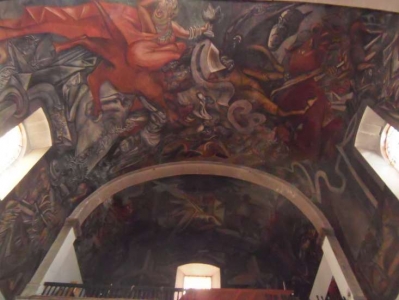
Orozco's last important work, the frescoes in the vaulting of the Templo de Jesus, are likely to last longer than those in the Preparatory School. Though the Templo is one of the oldest churches in Mexico, almost no one seems to know where it is. Neither vandalism nor the weather is likely to cause the deterioration the older murals have suffered.
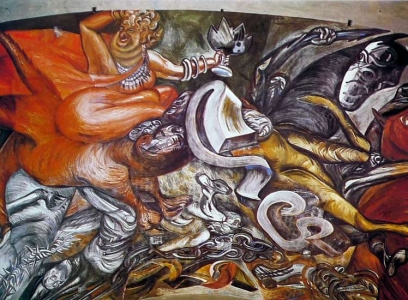
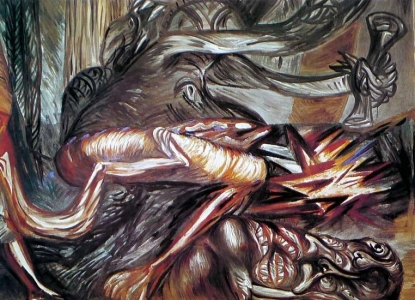
Knowing that these murals were painted during the war, when Orozco was at least pretending to be an admirer of Hitler, I may have read into them an overtone of sadism. The cool green, gray, and orange tonality is unpleasant, and the apocalyptic iconography is so cluttered with tangles of what look like tombstones and spaghetti as to be almost unreadable.
Justino Fernandez, Orozco's biographer, had helped Orozco study the text of the Apocalypse at the time the artist was working here, and thinks that familiarity with that text will lead to a greater appreciation of the artist's conception of God, Satan, and Man. He doesn't agree that the dominant mood is cruel. «Orozco is hard on God at the Day of Judgement,» he told me, «because he felt that the punishments meted out to sinful men were too severe.»